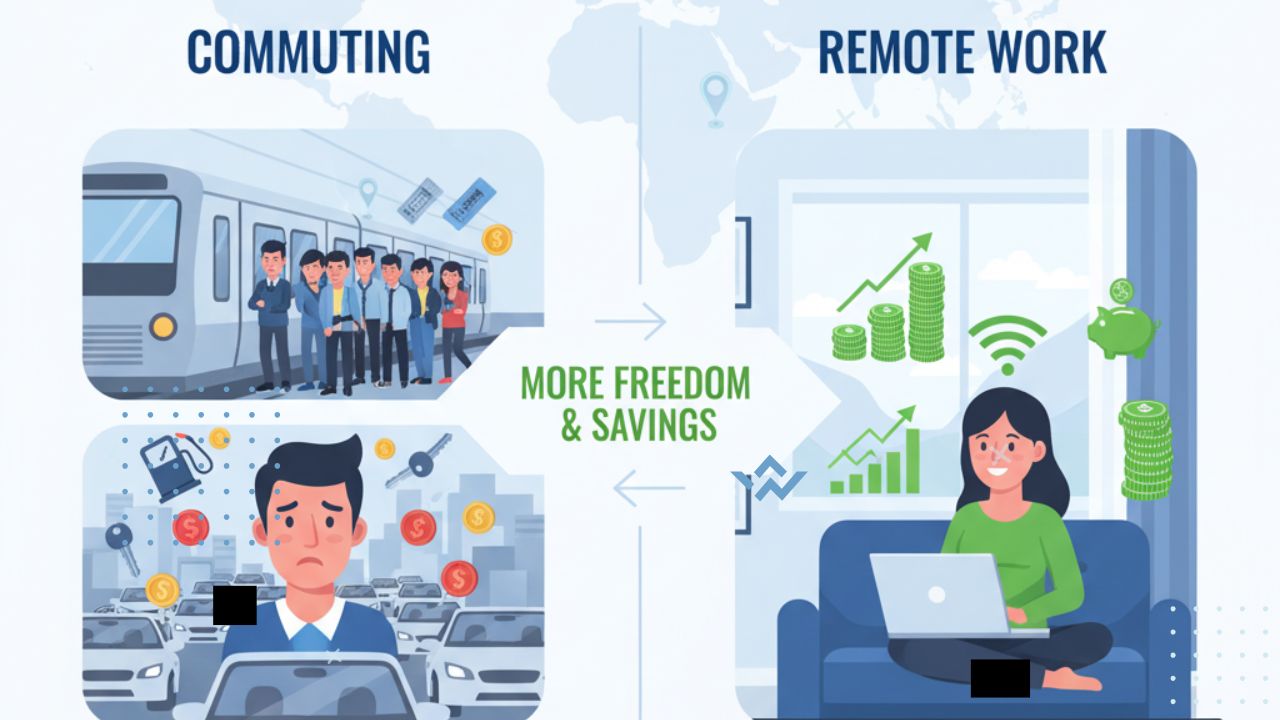
Hey, remote worker or curious commuter! Imagine skipping the daily grind of traffic or crowded trains and keeping more cash in your pocket. In 2025, with 32% of U.S. workers and 37% of Australians working remotely at least part-time (Gallup 2024; Timedoctor 2024), remote work is a game-changer for saving on commuting costs. Whether you’re in a bustling city like New York or a growing hub like Lagos, working from home can save you hundreds or thousands each year. Let’s break down how remote work cuts commuting costs across the globe, with real examples and tips to make it work for you. Grab a snack, and let’s chat about the savings!
Why Remote Work Saves You Money
Commuting isn’t just a time suck it hits your wallet hard. From gas and train tickets to parking fees, the costs add up fast. Globally, remote work saves workers $2,000–$7,000 annually, depending on location (Global Workplace Analytics 2025). In tech (growing at a 32.1% AI market CAGR, IndexBox 2025) and other fields, these savings boost your budget and reduce stress. Plus, fewer commutes mean a smaller carbon footprint 54 million tons less CO2 yearly (Global Workplace Analytics 2025). Let’s see how these savings play out worldwide.
Global Perspectives on Commuting Cost Savings
United States: High Costs, Big Savings
In the U.S., commuters spend $2,600–$6,000 yearly on gas, tolls, and parking (Global Workplace Analytics 2025).
- How Savings Work: Remote work cuts gas ($1,200/year for a 30-mile commute) and parking ($1,000/year in cities like Chicago).
- Example: John, a Seattle tech worker, saved $4,500 annually by working remotely, using the cash to pay off student loans (Forbes 2025).
- Tip: Track your commute costs with apps like Mint to see your savings grow.
Australia: Public Transport and Urban Wins
Australians spend $1,500–$5,308 yearly on public transport or car commutes (Timeout 2025).
- How Savings Work: WFH two days a week, as Victoria’s proposed law encourages, saves $1,000–$2,000 on train fares or fuel.
- Example: Emma in Melbourne saved $1,800 yearly on train tickets, splurging on a new home office chair (ABC News 2025).
- Tip: Use Australia’s tax deductions for WFH expenses like internet to boost savings (ATO 2025).
Europe: Dense Cities, High Fares
In Europe, commuting costs hit $1,200–$4,000 yearly, especially in cities like London or Paris (Statista 2025).
- How Savings Work: Remote work cuts train tickets ($2,000/year in London) and parking fees ($800/year in Paris).
- Example: Luca, a London-based data analyst, saved $2,500 by WFH, funding a family trip (Forbes 2025).
- Tip: Combine remote work with bike-sharing for occasional office days to save more.
Africa: Growing Remote Adoption
In African cities like Lagos, commuting costs $800–$2,000 yearly due to fuel and informal transport (IRENA 2025).
- How Savings Work: WFH saves $500–$1,200 on fuel or bus fares, critical in high-traffic cities.
- Example: Ayo, a Lagos freelancer, saved $1,000 yearly by working remotely, investing in solar power for his home office (Technofies 2025).
- Tip: Use low-bandwidth tools like Slack to work remotely despite connectivity challenges.
Asia: Mixed Infrastructure, Big Potential
In Asian cities like Mumbai or Manila, commuters spend $600–$2,500 yearly (Statista 2025).
- How Savings Work: Remote work saves $400–$1,500 on rickshaws, trains, or fuel.
- Example: Priya in Mumbai saved $1,200 by WFH, buying a laptop for freelance gigs (Technofies 2025).
- Tip: Explore coworking spaces for hybrid work to balance savings and connectivity.
How to Maximize Your WFH Savings
Want to make the most of remote work? Here’s how to turn those commuting savings into real benefits:
- Track Expenses: Use apps like YNAB to monitor what you save on gas, fares, or parking.
- Invest Savings: Put extra cash into savings, debt repayment, or upskilling (e.g., a Coursera course).
- Optimize Your Setup: Use energy-efficient devices to cut home office costs by $100–$200 yearly (Global Workplace Analytics 2025).
- Claim Tax Breaks: In Australia, claim deductions for WFH expenses like internet or electricity (ATO 2025).
- Stay Productive: Use tools like Notion to manage tasks, keeping your boss happy and WFH secure.
Challenges to Consider
Remote work isn’t all smooth sailing. Watch out for these hurdles:
- Home Office Costs: Internet and electricity can add $200–$500 yearly (Forbes 2025). Ask employers for equipment support.
- Connectivity Issues: In Africa and Asia, unreliable internet can disrupt WFH (IRENA 2025). Use hotspots as backups.
- Isolation: WFH can feel lonely. Join virtual coworking platforms like Focusmate to stay connected (Stanford 2025).
FAQs
Q: How much can I really save by working remotely?
A: Savings vary by location $2,000–$6,000 in the U.S., $1,000–$5,000 in Australia, and $400–$2,500 in Asia or Africa yearly, depending on your commute (Global Workplace Analytics 2025).
Q: Can I claim WFH expenses on my taxes?
A: In Australia, yes deduct internet, electricity, or equipment costs. Check local tax rules elsewhere, like IRS guidelines in the U.S. (ATO 2025).
Q: What if my employer won’t let me WFH?
A: In Australia, you can request flexible work under the Fair Work Act. Elsewhere, propose a trial period, showing productivity data to make your case (Fair Work Ombudsman 2025).