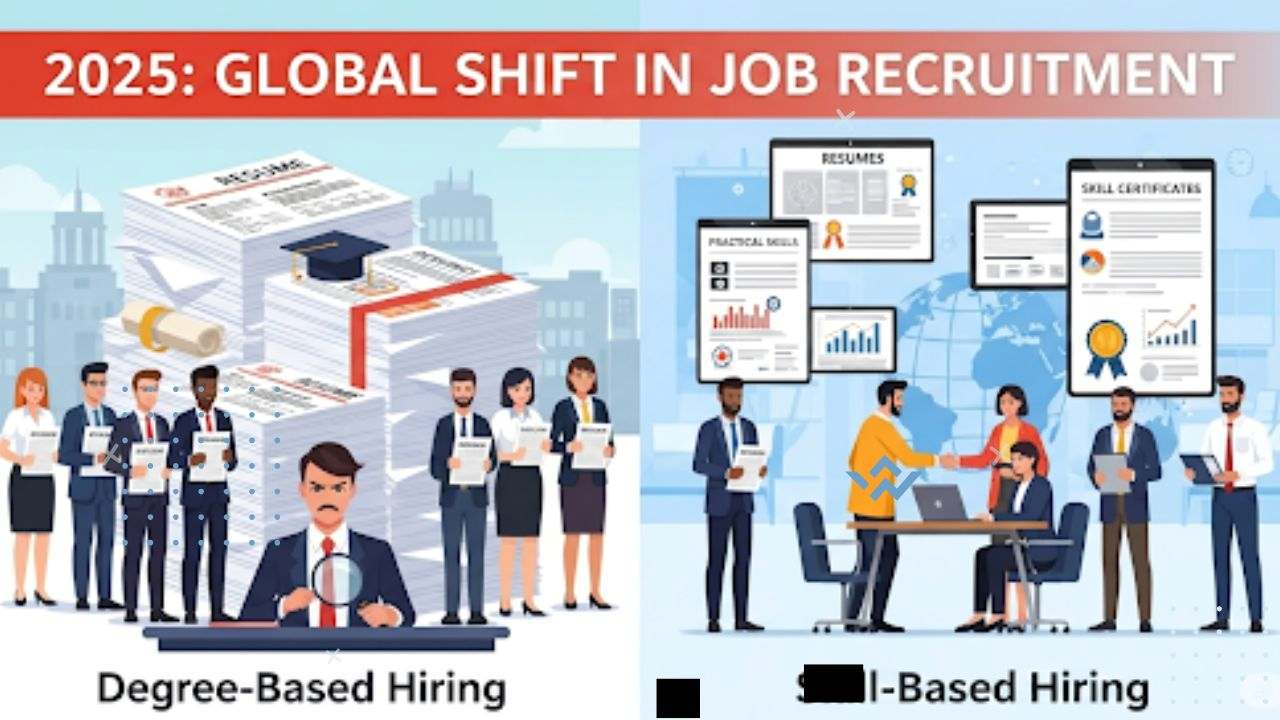
In 2025, the global job market is shifting rapidly, with 81% of employers prioritizing skills over degrees, unlocking 94% larger talent pools, per Test Gorilla’s 2024 survey (web:0). This trend, accelerated post-pandemic, is reshaping hiring practices, especially in high-growth sectors like tech (32.1% AI market CAGR, IndexBox, 2025) and healthcare (facing $70 billion in Medicaid cuts, Health Affairs, 2025). In Pakistan, where freelancing contributes $1 billion annually (Payoneer, 2025) and IT exports hit $3.2 billion (The Express Tribune, 2024), skill-based hiring offers new opportunities. This blog explores the differences between skill-based and degree-based hiring, their pros and cons, and actionable strategies for job seekers worldwide to thrive in this evolving landscape.
Understanding Skill-Based vs. Degree-Based Hiring
- Skill-Based Hiring: Focuses on a candidate’s demonstrable abilities, such as coding, data analysis, or patient care, assessed through tests, portfolios, or certifications (web:13). It prioritizes practical expertise over formal education, benefiting diverse talent pools.
- Degree-Based Hiring: Emphasizes formal qualifications like bachelor’s or master’s degrees, often seen as proof of foundational knowledge and dedication (web:7). It’s common in fields requiring licensure, such as medicine or law.
Why the Shift to Skill-Based Hiring?
The move toward skill-based hiring, gaining momentum since 2022, is driven by:
- Talent Shortages: 87% of companies face skill gaps, per McKinsey’s 2024 survey (web:5), especially in AI and cybersecurity.
- Diversity and Inclusion: Degree requirements exclude 76% of Black and 83% of Hispanic candidates, limiting diversity (web:1). Skills-based hiring promotes equity.
- Cost Efficiency: Companies report 90% fewer mis-hires and 9% higher retention with skills-based approaches (web:0).
- Global Trends: In Pakistan, initiatives like DigiSkills.pk train 2 million in skills like UX/UI design, aligning with the $3.2 billion IT export boom (web:10). Globally, companies like Google and IBM drop degree requirements for roles (web:14).
Pros and Cons for Job Seekers
Skill-Based Hiring
- Pros:
- Broader Opportunities: Opens jobs to non-degree holders, with 64.8% of employers using skills-based practices for entry-level roles (web:21).
- Flexibility: Candidates can showcase skills via portfolios, certifications (e.g., CISSP for IT), or freelance work (web:4).
- Diversity: Levels the playing field for those without access to higher education, especially in Pakistan (web:14).
- Example: A Karachi-based freelancer without a degree earned $30,000 on Fiverr with WordPress skills (technofies.com).
- Cons:
- Skill Assessment Challenges: Measuring skills is tough, with 47% of HR managers unaware of workforce gaps (web:20).
- Competition: High applicant volume (500–2,000 applications/month, web:0) requires standout portfolios.
- Lower Salaries: Non-degree roles may pay less initially, per UK data (web:14).
Degree-Based Hiring
- Pros:
- Standardized Metrics: Degrees provide a clear benchmark, valued in fields like medicine, law, and engineering (web:3).
- Career Preparation: Programs offer internships and projects, building resumes (web:12).
- Higher Salaries: Degree-holders often earn more in specialized roles (web:14).
- Example: A U.S. engineer with a degree landed a $120,000 job at a startup (Glassdoor, 2025).
- Cons:
- Exclusivity: Excludes 66% of workers without degrees, disproportionately affecting minorities (web:6).
- Degree Inflation: Many roles don’t need degrees, yet list them, per Harvard’s analysis (web:0).
- Cost and Time: Degrees require years and thousands of dollars, a barrier in Pakistan (web:4).
Key Trends in 2025
- Hybrid Hiring Models: 70% of employers blend skills and degrees, especially in finance and tech, valuing both practical skills and theoretical knowledge (web:3).
- AI and Technology: AI tools like skills ontologies and pre-employment tests streamline hiring, reducing bias by 20% (web:17). In Pakistan, freelancers use AI for portfolios (Payoneer).
- Government Support: In the U.S., states like Maryland drop degree requirements for public jobs (web:14). In Pakistan, DigiSkills.pk boosts skill-based training (Dawn, 2025).
- Freelancing Surge: Pakistan’s 3 million freelancers leverage platforms like Upwork for skill-based roles, earning $20–$150/hour (Payoneer, 2025).
Strategies for Job Seekers
- Develop In-Demand Skills:
- Focus on high-growth areas like AI, data analytics, or telehealth. Learn Python, Tableau, or EHR systems via free platforms like DigiSkills.pk or Coursera (web:5).
- Example: A Pakistani freelancer learned UX/UI design, earning $1,000/month on WorkChest (workchest.com).
- Build a Portfolio:
- Showcase projects on GitHub, Behance, or personal websites. Include metrics (e.g., “Increased traffic by 20%”) to stand out (web:9).
- Example: A U.S. data analyst’s Tableau dashboard on GitHub secured a $100,000 fintech role (TechCrunch, 2025).
- Earn Certifications:
- Obtain credentials like Google Data Analytics or AWS Certified Developer, valued by 87% of executives (web:1).
- Tip: In Pakistan, use DigiSkills.pk for free certifications (beingguru.com).
- Leverage Freelancing Platforms:
- Use Upwork, Fiverr, or Toptal to gain experience and build reviews. Optimize profiles with keywords like “AI development” (web:15).
- Example: A Lahore-based developer earned $40,000 on Freelancer.com with coding projects (technofies.com).
- Prepare for Skills Assessments:
- Practice coding tests (LeetCode) or design challenges (Figma). 78% of companies using assessments report better hires (web:17).
- Tip: TestGorilla offers free practice tests (web:20).
- Network Actively:
- Engage on LinkedIn or X to connect with startups in Pakistan’s $200 million ecosystem (Dawn, 2025). Attend virtual job fairs (LinkedIn, 2024).
- Prioritize Cybersecurity:
- Use MFA and secure Wi-Fi for online assessments, reducing breach risks by 50% (Gartner, 2025).
Challenges and Considerations
- Skill Verification: Companies struggle to assess skills, with only 4 in 700 non-degree candidates hired despite relaxed requirements (web:6).
- Cultural Barriers: In Pakistan, degree prestige persists (Eurasia Review, 2025). Highlight certifications to counter bias.
- Connectivity Issues: Internet disruptions in Pakistan (spocket.co) require backup hotspots for virtual assessments.
- Burnout Risk: Freelancers face pressure from global clients. Use mindfulness apps like Headspace to manage stress (Forbes, 2025).
Global and Pakistan Perspectives
- North America/Europe: Tech giants like Google prioritize skills, with 18% of U.S. job postings requiring degrees (web:17).
- Pakistan: Freelancers leverage skill-based platforms like Upwork, aligning with the 47% gig economy growth (Payoneer).
- ASEAN/Africa: Skills-based hiring rises due to connectivity improvements and diverse talent pools (IRENA, 2025).
Conclusion
Skill-based hiring is transforming the global job market in 2025, offering opportunities for non-degree holders while complementing degree-based approaches in fields like healthcare and tech. Job seekers in Pakistan and worldwide can thrive by developing in-demand skills, building portfolios, and leveraging platforms like Upwork. Despite challenges like skill verification and competition, strategic preparation ensures success. Embrace these trends to navigate the evolving hiring landscape and secure high-growth roles.