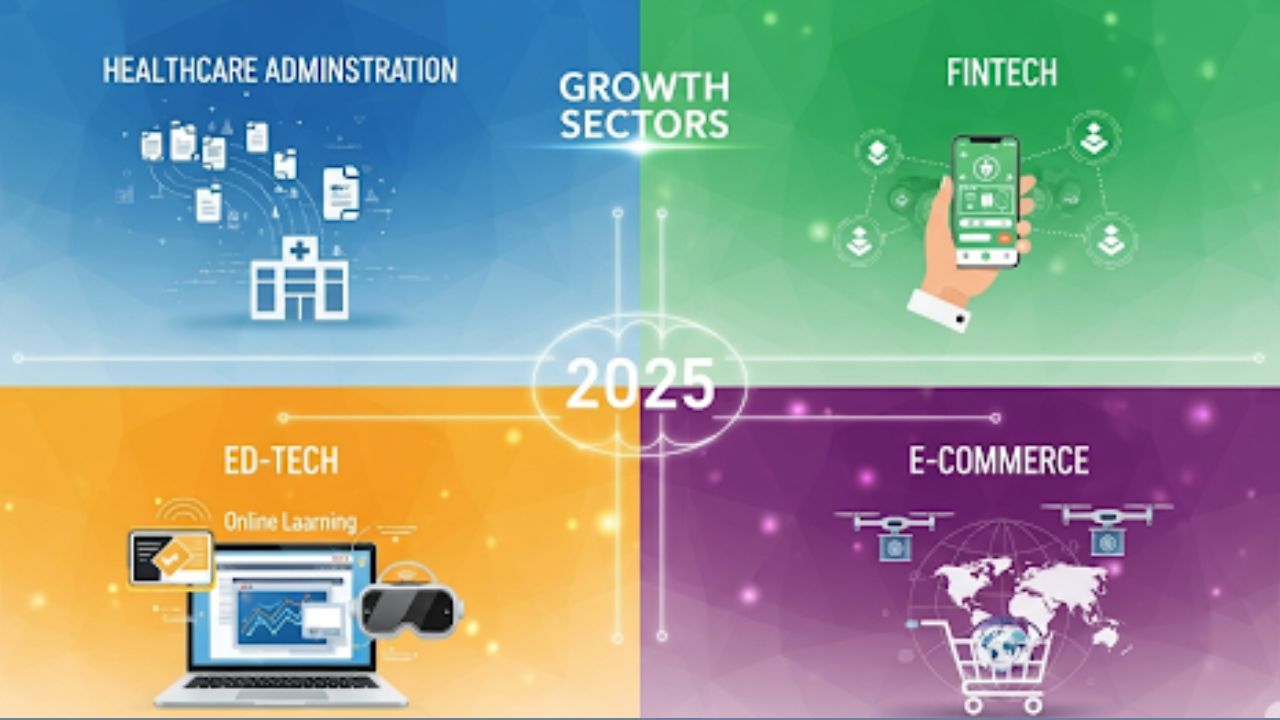
In 2025, global economies are navigating a dynamic landscape shaped by technological advancements, shifting demographics, and evolving consumer behaviors. Four sectors—healthcare administration, fintech, educational technology (ed-tech), and e-commerce—are experiencing rapid growth, driven by innovation and increasing demand.
1. Healthcare Administration: Streamlining Care Delivery
Overview
Healthcare administration is transforming to address staffing shortages, budget constraints, and rising patient demand, with U.S. healthcare spending projected to grow 5.4% annually through 2032 (CMS, 2025). Administrators leverage technology to optimize workflows, ensuring efficient care delivery in hospitals and clinics.
Key Trends
- AI and Automation: AI tools like ambient intelligence and generative AI streamline administrative tasks, reducing documentation time by 30%, per a 2025 HIMSS report. For example, AI-based triage systems cut patient wait times by 25% in rural hospitals (StartUs Insights, 2024).
- Remote Patient Monitoring (RPM): IoT-enabled wearables and smart beds track patient vitals, improving outcomes by 15% and reducing costs, per HealthTech Magazine 2025.
- Telehealth Expansion: Virtual care utilization is rebounding, with 46% of patients using telehealth in 2024, up from 11% pre-COVID (McKinsey, 2025), easing administrative burdens.
- Cybersecurity Focus: With 88% of 2024 healthcare breaches human-driven (Verizon), zero-trust practices like MFA are critical for protecting patient data.
Opportunities
- Jobs: Roles like healthcare IT specialists, compliance officers, and RPM coordinators are in demand, with health services manager jobs growing 28% through 2032, per BLS 2025.
- Investment: Startups like LookDeep Health, offering AI-driven clinical platforms, raised $10 million in 2024, signaling growth potential.
- Skills Needed: Proficiency in EHR systems, HIPAA compliance, and AI tools like Microsoft Copilot.
Example
A healthcare administrator in a U.S. hospital implemented an AI-based EHR system, reducing documentation errors by 20% and saving $500,000 annually, aligning with 2025’s focus on efficiency (HIMSS).
2. Fintech: Revolutionizing Financial Services
Overview
Fintech, growing at a 26% CAGR through 2030 (IndexBox), is reshaping banking, payments, and investments with digital solutions. With 18% job growth projected in financial services from 2023–2033 (CareerOneStop, 2025), fintech is a hotspot for innovation.
Key Trends
- AI and Blockchain: AI-driven fraud detection (e.g., using Python and TensorFlow) cuts losses by 30%, while blockchain ensures secure transactions, saving $150 billion annually by reducing fraud (BIS Research, 2025).
- Mobile Banking and Payments: Buy-now-pay-later platforms and real-time payment systems like Zelle are driving 20% annual growth in digital transactions (Statista, 2025).
- Embedded Finance: Retail platforms integrate payment solutions, with 40% of e-commerce sites offering embedded fintech by 2025 (Forbes).
- Regulatory Navigation: Fintech firms face tighter regulations, requiring compliance experts to align with GDPR and U.S. financial laws.
Opportunities
- Jobs: Demand for AI specialists, blockchain developers, and compliance analysts is surging, with salaries averaging $120,000 in the U.S. (Glassdoor, 2025).
- Investment: San Francisco-based fintech startups like Chime raised $500 million in 2024, per InnReg, fueling digital banking growth.
- Skills Needed: Expertise in Python, blockchain, and cybersecurity tools like CrowdStrike.
Example
A fintech startup deployed an AI-driven payment platform, reducing transaction errors by 25% and boosting customer retention by 15%, per a 2025 case study.
3. Ed-Tech: Transforming Learning
Overview
Ed-tech, with a 22.3% CAGR through 2030 (Allied Market Research), is revolutionizing education through digital platforms, addressing the need for personalized and accessible learning. Educational support services are projected to grow 22% by 2033 (CareerOneStop).
Key Trends
- AI-Powered Learning: Platforms like Coursera use AI to tailor courses, improving completion rates by 20%, per a 2025 EdTech Magazine report.
- AR/VR Integration: VR training, used in 30% of medical schools, enhances skill retention by 38% compared to traditional methods (Harvard Business Review, 2025).
- Micro-Credentials: Demand for short, skill-specific certifications (e.g., Google’s AI Essentials) is rising, with 50% of learners seeking job-ready skills (Forbes, 2025).
- Global Accessibility: Ed-tech bridges education gaps in regions like Africa, where mobile learning apps grew 25% in 2024 (UNESCO).
Opportunities
- Jobs: Roles like instructional designers, AI content developers, and VR trainers are in demand, with 15% job growth projected (BLS, 2025).
- Investment: Ed-tech startups like Duolingo raised $200 million in 2024, per StartUs Insights, focusing on AI-driven language learning.
- Skills Needed: Proficiency in LMS platforms, AR/VR tools, and data analytics.
Example
An ed-tech platform implemented VR-based medical training, reducing training costs by $73 per student and improving performance by 20%, per a 2025 Nature study.
Challenges Across Sectors
- Cybersecurity Risks: All sectors face rising threats, with 27% more ransomware attacks in 2024 (Verizon). Zero-trust practices are critical.
- Skill Gaps: Demand for AI, cybersecurity, and IoT skills outpaces supply, requiring upskilling (World Economic Forum, 2025).
- Regulatory Pressures: Healthcare and fintech navigate strict compliance (e.g., HIPAA, GDPR), while e-commerce faces data privacy laws.
- Digital Disparities: Rural areas and developing regions like Africa face connectivity challenges, limiting ed-tech and e-commerce access (IRENA, 2025).
Strategies for Professionals
- Upskill Strategically: Learn AI tools (e.g., Python, TensorFlow), cybersecurity certifications (e.g., CISSP), and platform-specific skills (e.g., Shopify, Canvas).
- Tailor Resumes: Use keywords like “telehealth,” “blockchain,” or “AI personalization” to pass ATS, used by 75% of employers (LinkedIn, 2024).
- Leverage Asynchronous Tools: Master Slack and Loom for remote collaboration, critical for global teams (Gartner, 2025).
- Network Digitally: Engage on LinkedIn, GitHub, or ed-tech forums to access opportunities in these sectors.
- Adopt Smart Workspaces: Use IoT-enabled home offices with ergonomic designs to boost productivity, saving 5–7 hours weekly (Deloitte, 2025).
The Future of These Sectors
By 2030, these sectors will evolve with AI, AR/VR, and IoT advancements. Healthcare will integrate ambient intelligence for telehealth, fintech will expand embedded finance, ed-tech will scale VR training, and e-commerce will leverage AR for virtual try-ons, 2025. Developing regions like ASEAN and Africa will drive growth as connectivity improves, addressing digital disparities (IRENA).